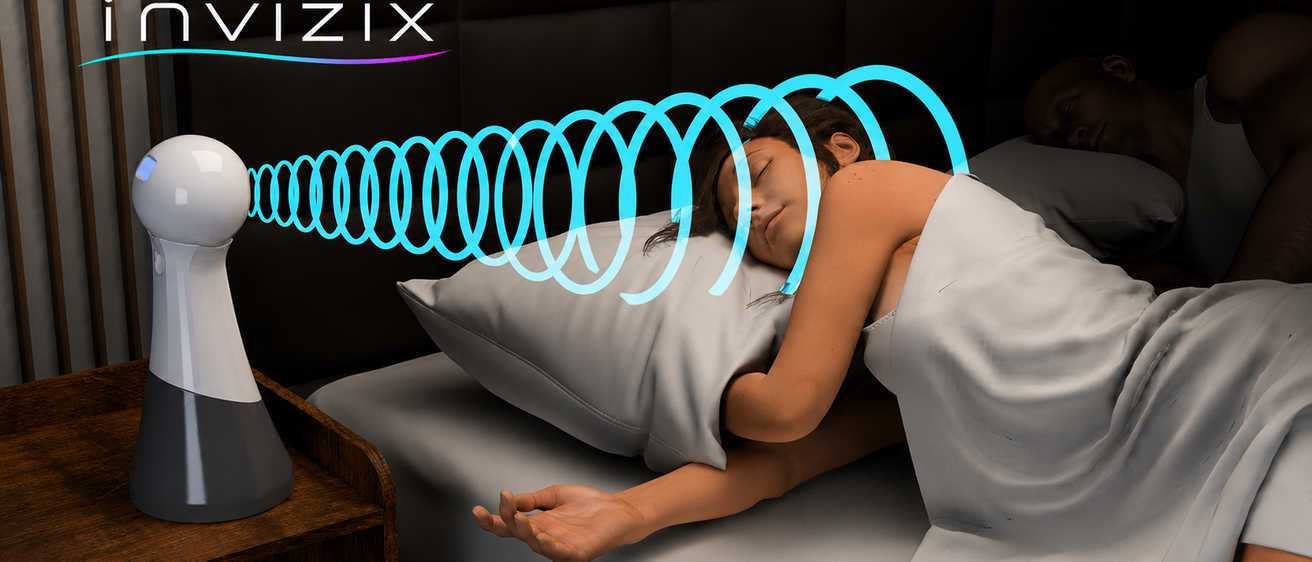
An Iowa City-based biotech startup has created a non-invasive medical device the company hopes is capable of treating chronic diseases, including certain cancers, at the source.
Invizix, formerly Geminii Health, was founded by University of Iowa doctoral graduate Calvin Carter in 2016, but the company has made significant strides in bringing its product to market over the past several years.
The company recently rebranded to reflect its vision of building what it calls “invisible medicines” — therapies designed to fit seamlessly into patients’ daily routines.
The medical device, which the company named the Nexa, delivers treatment while the patient is sleeping, Mr. Carter said. It’s designed to sit next to the patient’s bed rather than needing to be implanted or worn, with the goal of treating multiple common and deadly diseases from a single home-based device. It was important to the company that the Nexa could be easily integrated into patients’ routines and not impact quality of life, he said.
“It’s pretty remarkable the effects it has in killing cancer cells and not harming other parts of the body,” he said.
The treatment is meant to be used in combination with chemotherapy and radiation during all stages of brain cancer, from stage 1 to stage 4.
“Our goal is to maximize outcomes and give patients the best chance of fighting cancer,” he said.
Mr. Carter, who earned his Ph.D. in neuroscience, said he originally planned to attend medical school, but that all changed while working in the lab at UI the summer before medical school.
“About four weeks before moving for medical school, we made a surprise discovery — certain electromagnetic fields could be used to change blood sugar,” he said.
“Electromagnetic fields are all around us — in bluetooth, WiFi, cellphones,” he explained. “Right now we live under the assumption that these fields don’t do much to our biology. But we’re inundated day to day, and some of these fields have pretty profound effects on biology.”
Mr. Carter and his team want to better understand how these fields impact health and biology so they can harness them therapeutically.
The team’s original research focused on diabetes therapies, but has recently added brain and lung cancer therapies to its portfolio. Overall, brain and spinal cord cancers make up only about 1% of new cancers diagnosed in the U.S. each year, according to the American Cancer Society. But certain tumors can be extremely deadly, with five-year survival rates for glioblastoma patients ages 40 and older at only 6%.
“We initially wanted to focus on cancers with unmet needs — brain cancer has one of the lowest survival rates,” he said. “We want to give patients a solution while they are fighting for their lives.”
There’s a lot of behind-the-scenes work to move the device from the bench to the bedside, Mr. Carter explained. Invizix has been busy raising money, filing patents, recruiting advisors to help guide and design clinical trials, and working with the U.S. Food and Drug Administration to start new clinical trials.
“We did a single patient study a few years ago in brain cancer, which was encouraging. Now we are gearing up to start two trials in brain cancer and metabolic syndrome,” he said. “We need to understand the mechanisms and reliably produce effects, and to make sure our findings hold up when moving
toward humans.”
Mr. Carter said funding from the state of Iowa and Iowans, as well as the National Institutes of Health (NIH), has been crucial in the academic scientific research and in the company’s success. The foundational science was initially supported by the Janice and Herbert Wilson Family Foundation, starting in 2018; and later received funding support from NIH grants and Thrive Brain Cancer, a Cedar Rapids nonprofit focused on finding cures for brain cancer. More recently, the company received investment from Innoventure, the Iowa state venture fund, and in 2025 was awarded an NIH Small Business Innovation Research (SBIR) grant.
“The culture of community and support in Iowa is uncommon,” he said. “When Iowans face challenges, we stick together and support each other to build a better future together.”